
Exploration 4A New Home?
During our last phase of inquiry, we focused on Malak’s journey. Now we are ready to consider what happened to Malak once her journey ended and she found herself in her new home. Looking back at things we asked related to this, we collected these questions to continue our inquiry.
- Where did Malak end up?
- Have she and her family found a permanent home? Or are they in a refugee camp?
- Is Malak going to school?
- Does Malak remember and miss her home?
- Has she made new friends?
- How many other children are experiencing similar situations?
- What will the long term effects of Malak’s journey be as she grows up?
- How are people or organizations helping Syrian refugees?
We learned that many Syrian refugees fled, looking to reach Europe. We want to know if this is where they finally settle. Where in Europe do Syrian refugees settle? Do any of them continue on to other countries outside of Europe?
With this in mind, we started off by searching: ‘Where do Syrian refugees go?’.
The first source that we explored, Where Syrian refugees have resettled worldwide, is loaded with statistics and helpful graphics that show how, as the title indicates, that Syrican refugees have spread across the world. That said, we were surprised to learn that the largest concentration of Syrican refugees is still in the Middle East. Even more surprising is the fact that nearly half of all Syrian refugees are internally displaced within Syria. We added to our ever growing list of questions: What happens to those families who are unable to get out of Syria? How do the experiences of refugees compare based on where they end up?
The next source we explored, By the Numbers: Syrian Refugees Around the World, is a project of PBS and Frontline. In addition to giving us comprehensive information and visuals about the settlement of refugees, the site also is rich with additional links for further research. We started a new page to our notebook for sources to return to later, and added to this list For Sama, a documentary Produced by Frontline that we plan to watch and Internal Displacement Monitoring Center, so we can learn more about the experience of Syrians who are internally displaced.
We were curious about Syrian refugees in the United States, so we initiated a new search:
‘where do Syrian refugees go in the US’ which brought us to Top Destinations for Syrian Refugees: Michigan and California.
This source provides a state by state breakdown of Syrian refugee arrivals from October 2015 through July 2016. Considering we are doing this research nearly four years later, we knew we needed to get more current information.
We decided to do a search of ‘where do Syrian refugees go in the US 2019’’ and the title of this Washington Post article pulled us in: The U.S. has slashed its refugee intake. Syrians fleeing war are most affected.
Here we learned more about the policies that the United States has had about Syrian refugees historically as well as how the present day policies are putting so many more people at risk. We know that we still have only a basic understanding of government policies and the impact on human rights. We added to our notebook these questions: What are the current policies regarding Syrian refugees? How can we put pressure on our representatives to do more to change policies to be more inclusive? What human rights organizations are working to protect refugees? How else can we help?
Once we added our questions in our notebook, we revisited our inquiry about life in a refugee camp.
After learning that the majority of Syrian refugees have been placed in refugee camps, we wondered again about Malak and her family. If they are in a refugee camp, what is life like there? We hoped that learning about life in a refugee camp would also give us some insight into the emotions, memories, hopes and dreams of children like Malak.
So we searched the following: What is life like in Syrian refugee camps for kids? This search yielded a lot of stories and reports about childrens’ lives in refugee camps from the adult point of view. We really wanted to hear directly from kids about their experiences, so we adjusted our search to the following phrase: Syrian children refugee stories. Jackpot!
The first source to draw our attention was a publication by Unicef that includes four letters by Syrian refugee children in their own words. The four children wrote from Greece and Germany. Two of the letter writers are temporarily resettled and the other two are still living in the camps. These letters are filled with honest accounts of their sorrows and dreams.
The next source we discovered on our search was this video about a young girl named Niroz and what her life is like in a Syrian refugee camp. Niroz tells her story as she gives a tour of her living conditions in the camp and talks about education, friends and shares her opinions about her new life. Watch the video.
Videos really helped to give us a clearer sense of the sights and sounds of refugee living. We noticed that Niroz’s story was filmed more than five years ago. We wanted to know more about what life is like for young refugees nowadays. Therefore we searched: Syrian children refugees in their own words 2020. There were many contemporary videos and articles but most of them didn’t feature children.
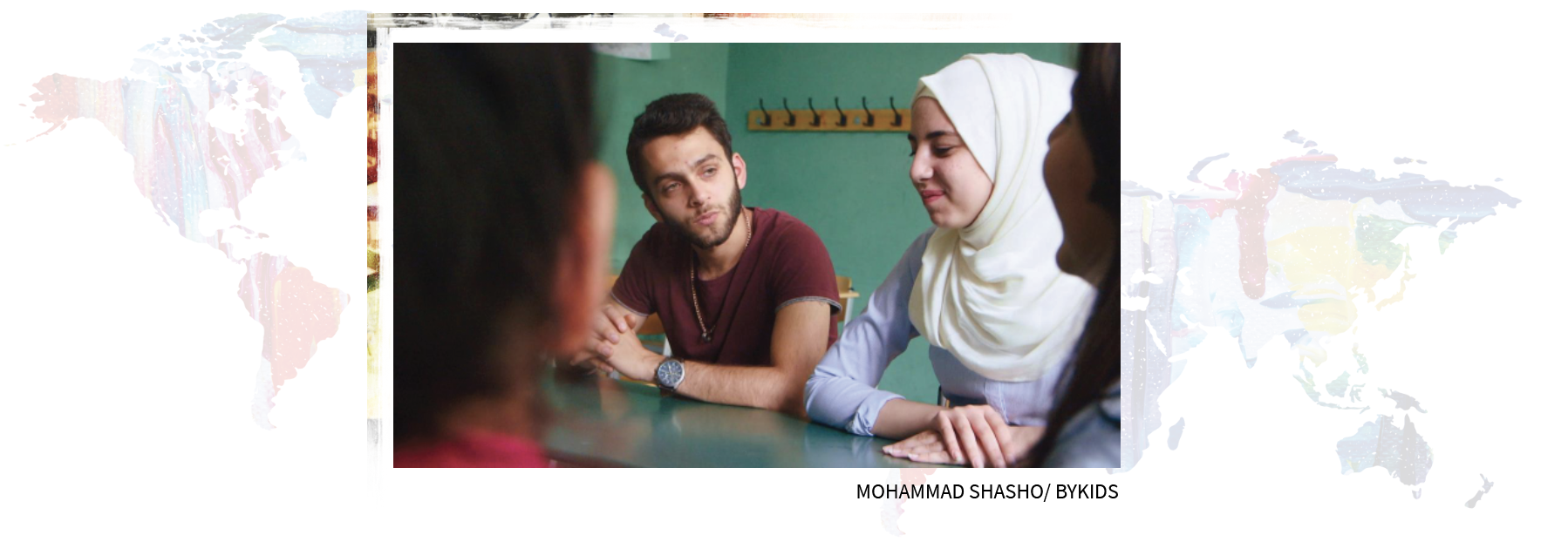
However, the search turned up this video, made in 2018, titled Out of Allepo: A Teen Refugee Tells His Story.
Mohammad and his family fled their home in Aleppo, Syria, in 2013 as civil war consumed the country. He tells their story and gives voice to fellow refugees in a new documentary created as part of the BYkids program, which mentors young filmmakers.
Next we discovered this photo essay, World Vision: Syrian Refugee Children: A story in 23 photos.
The photographs in this series were taken in a refugee camp in Lebanon. The images definitely convey living conditions and daily life in a refugee camp.
The aforementioned sources helped us to gain a better understanding of what young people’s lives are like in refugee camps, and we have begun to crack the egg about policies and organizations having to do with refugees. But, we also can’t just walk away from the information we’ve gleaned about living in refugee camps without wondering about the long term effects on youth as they grow up. After experiencing loss of home, and/or friends and family-- normalcy in daily living, how does such loss change a person? We searched the phrase: ‘long term effects of being a refugee.’
The first article to catch our attention was titled 'How does being a refugee affect your health?'
This article does a great job of explaining how health is defined and discusses long term emotional and physical effects of a group of refugees who resettled in Hamilton, Canada.
Next, we saw a search suggestion: Refugee Trauma Statistics. We went for it and found this page
on a site powered by the National Center for Trauma Stress Network (NCTSN). The section that we found most helpful is introduced with the following statement:
Many refugees, especially children, have experienced trauma related to war or persecution that may affect their mental and physical health long after the events have occurred. These traumatic events may occur while the refugees are in their country of origin, during displacement from their country of origin, or in the resettlement process here in the US.
The section also has segments to explore. One of the segments that we found really interesting discusses the types of trauma children experience as refugees.
Another segment discusses the physical effects of trauma. This segment even included age-specific physical effects of trauma.
We learned a lot from the NCTSN about what refugee youth have to deal with long after camp life. While most of our research until this point has been on Syrian refugees, this search deepened our understanding about the trauma caused by having to leave home and all of the disruptions associated with leaving.
But what about refugees from other countries? What about the policies that help reduce or increase trauma in refugees? The ‘what about’ questions began to creep in and when we opened our notebook, we realized that we had already been rounding up questions like this throughout our search.
We may have scratched the surface of life before, during and after being a refugee--beginning with Malak’s journey, but it is time to dig deeper and to begin considering personal ways to take action on these issues. Some of your questions about Malak may be similar to ours, but you may also have questions that are different. In order to connect and care, it’s important to pay attention to what compels and interests you most. We’ve found that when we pay attention to what interests us most, our learning remains interesting and leads to meaningful action. One way to take action is to begin your own exploration! Learn how in section 5.
Rock Your World is a program of Creative Visions

Rock Your World is a Program of Creative Visions, a 501(c) (3) organization that supports creative activists - individuals who use the power of media and arts to create positive change in the world.